
Last updated: June 30, 2026
Nearly one in two Canadian SMBs waits more than 30 days past the due date to get paid. This isn't a problem of dishonest clients — it's almost always a problem of timing. Businesses that get paid faster don't push harder, they follow up at the right moment, with the right tone, through the right channel.
Legal disclaimer. This article is for informational purposes only. The author of this blog is not a financial professional, we do not provide legal advice, and Paymely is not a collection agency.
Summary
The cadence that works for payment reminders follows six touchpoints: a friendly reminder 3 to 7 days before the due date, a reminder on the due date itself, a first follow-up 3 to 7 days after, a firm reminder at 14 days overdue, a final notice at 30 days, then a pre-collection notice at 45-60 days [7]. Combining email and SMS, automating the sending, and stopping as soon as payment is detected — that's what reduces late payments by about 14 days on average [4].
Key takeaways
A first reminder sent before the due date changes the whole dynamic: it's a heads-up, not a demand.
Six touchpoints are enough in most cases, spaced 7 to 14 days apart.
Automated reminders cut collection times and free up administrative time [4][10].
SMS doubles the response rate when combined with email.
The tone should escalate gradually, never abruptly.
In Canada, compliance (PIPEDA, CASL) requires clear consent for electronic communications.
A formal notice (mise en demeure) isn't a reminder — it's the legal step that comes after.
A good follow-up tool automatically stops reminders as soon as payment is detected [9].
What does "payment reminder" mean?
A payment reminder is a message sent to a customer to let them know that an invoice is coming due or is overdue. It's a business communication—courteous and factual—that comes before any legal action.
There are three levels:
Preventive reminder : sent before the due date, with an informative tone.
Follow-up reminder : sent after the due date, with a more direct tone.
Formal notice : a formal act with legal weight, usually sent by registered mail. (Paymely cannot assist with this step)
In Quebec, the term "relance de paiement" is often used as a synonym.
How often should you send payment reminders?
The ideal frequency revolves around six reminders spaced 7 to 14 days apart, from the friendly notice to the pre-collections stage. Too few reminders let the invoice sink to the bottom of the pile. Too many end up as spam and damage the client relationship.
Here's a proven schedule [7]:
(These results are for illustrative purposes only and may vary.)
Step | Timing | Recommended channel | Tone |
|---|---|---|---|
1. Friendly notice | D-5 to D-3 | Cordial | |
2. Due date | D | Neutral | |
3. First follow-up | D+5 to D+7 | Email + SMS | Direct |
4. Firm reminder | D+14 | Email + SMS | Firm |
5. Final notice | D+30 | Registered email | Serious |
6. Pre-collections | D+45 to D+60 | Letter + email | Formal |
Decision rule: if the invoice goes unanswered past 60 days, it's time to move on to collections or a formal demand letter.
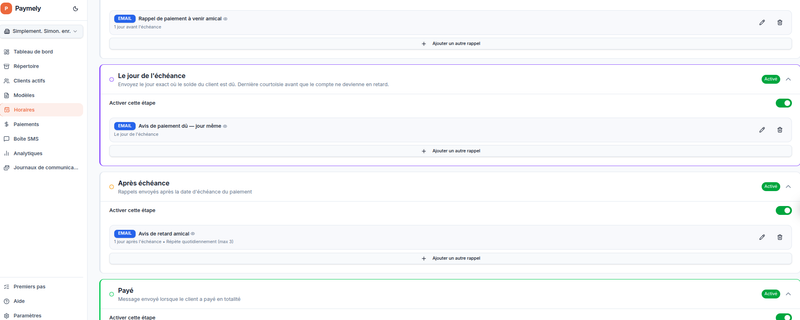
Below is a real interface showing a client's schedule.
Best practices for reminder frequency
Reminders should be predictable, polite and progressive. A client who's given advance notice pays faster than one who's caught off guard by an aggressive follow-up.
A few principles that really make a difference:
Send early in the morning (between 8am and 10am), Tuesday through Thursday. Mondays are overloaded, and Fridays get ignored.
Vary your channels : email for a written record, text messages for speed. Combined reminders noticeably improve response rates.
Personalize : contact name, invoice number, exact amount, direct payment link.
Stop everything as soon as payment is received. Nothing annoys a client more than getting a reminder after they've already paid [9]. Paymely has a payment detection system that takes care of this.
How many reminders before legal action?
Generally, three to four reminders after the due date are enough before considering a formal demand letter. Beyond 60 days overdue with no response from the client, legal action becomes a reasonable option.
Typical sequence:
Three commercial reminders (email/SMS)
One formal final notice
One formal demand letter by registered mail
Referral to a collection agency or the courts
Clear reminders sent at the right time reduce the risk of invoices turning into serious bad debt [5].
What’s the difference between a reminder and a formal notice (mise en demeure)?
A reminder is commercial in nature. A formal notice is legal. A reminder simply asks for payment; a formal notice demands payment under threat of legal action.
Element | Payment reminder | Formal notice |
|---|---|---|
Nature | Commercial | Legal |
Format | Email, SMS, phone call | Registered letter |
Tone | Friendly to firm | Formal, threatening |
Effect | No legal effect | Starting point for late-payment interest |
Timing | Day 5 to Day 45 | Day 45 and beyond |
How to write an effective payment reminder
A good reminder fits in under 150 words and includes five essential elements: a clear subject line, a personalized greeting, an invoice recap (number, date, amount), a specific request, and a payment link.
We have plenty of ready-made templates for your business and your clients. You can tweak them or create new ones to suit your specific use case.
Template — first reminder (Day 5) :
Subject: Invoice #2041 — a friendly little reminder
Hi [First Name],
Just a quick note to remind you that invoice #2041 for $1,240, dated May 15, was due on June 14. This may simply have slipped your mind.
You can pay in one click here: [payment link]
Thanks in advance, and don't hesitate to reach out if you have any questions.
[Signature]
Template — firm follow-up (Day 14) :
Subject: Invoice #2041 — 14 days overdue
Hi [First Name],
Despite our previous messages, invoice #2041 remains unpaid. The amount due is $1,240. Please arrange payment before [date] to avoid late fees.
Payment link: [link]
Best regards, [Signature]
Payment Reminder Templates
Here are three short templates suited to different stages of the follow-up schedule.
Advance Notice (D-3) — SMS:
"Hi [First Name], quick reminder: your invoice #2041 ($1,240) is due on June 14. Link: [url]. Thanks!"
Final Notice (D+30) — Email:
"Dear Sir/Madam, unless invoice #2041 ($1,240) is settled within 7 days, the file will be forwarded for a formal demand letter. Payment link: [url]."
Pre-Litigation (D+45) — Letter:
"Without payment in full within 10 days, we will initiate collection proceedings. A formal demand letter will be sent to you."
Laws and Regulations on Payment Reminders in Canada
In Canada, electronic reminders are governed by the Canada's Anti-Spam Legislation (CASL) and the PIPEDA for personal information protection. Quebec adds Law 25 on data protection.
Key points to follow:
Obtain explicit or implied consent before sending commercial emails and text messages.
Include clear identification of the sender and an unsubscribe mechanism.
Keep a record of communications (useful in case of a dispute).
When it comes to payment deadlines, the federal Interest Act sets the default rate at 5% if nothing is specified in the contract.
A Canadian-hosted reminder tool makes compliance easier — your data stays in the country, and the templates already include the required legal notices.
When should you send the first reminder after invoicing?
The first reminder should go out 3 to 7 days before the due date, not after. This is what's known as an advance notice: it prevents the invoice from being forgotten and frames the conversation in a positive light.
If you wait until the due date to reach out, you've already lost time. Companies that automate a preventive reminder see their payment delays drop significantly [8].
Combien de temps entre chaque rappel ?
The ideal spacing is 7 to 14 days. Any shorter, and it starts to feel like harassment. Any longer, and the client forgets.
Typical timeline:
Between the advance notice and the due date: 5 days
Between the due date and the first follow-up: 7 days
Between the first follow-up and the firm reminder: 7 days
Between the firm reminder and the final notice: 14 days
Between the final notice and pre-collections: 15 days
Email or letter: which should you choose?
For the first few reminders, email is more effective — it's fast, low-cost, traceable, and comes with an integrated payment link. SMS pairs perfectly with it for short, urgent reminders.
A registered letter remains essential for the final notice and formal demand, since it serves as legal proof of receipt. The winning combination is digital for cadence, paper for formality.
Common mistakes in payment reminders
A few classic pitfalls we see among SMBs:
Waiting too long before sending the first reminder (often 30 days, sometimes more).
Using an aggressive tone right off the bat, which sours the relationship over what might just be honest oversights.
Forgetting to stop the reminders after payment has been made — a classic mistake that destroys trust.
Sending the same message at every stage, with no escalation.
Neglecting other channels : email only, with no follow-up text messages.
Not keeping records of what was sent, which complicates things if legal action becomes necessary.
Hounding the client several times a day.
Tools to automate payment reminders
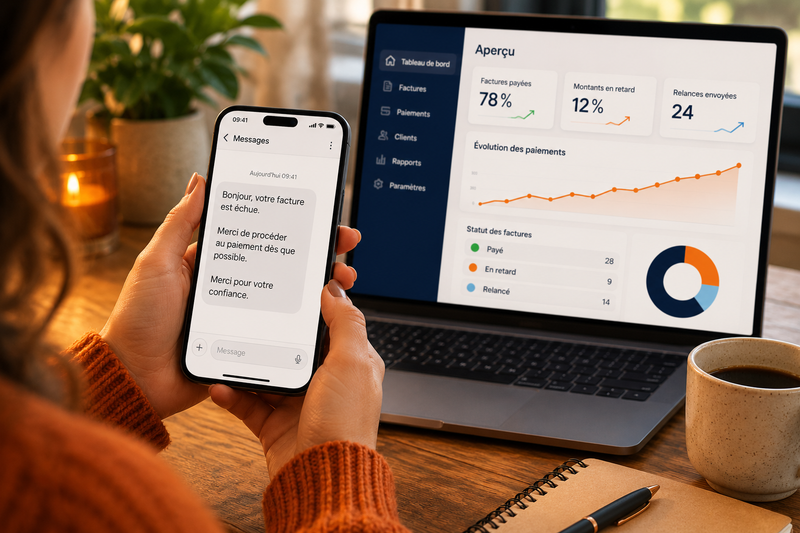
Automation turns collections follow-up from a chore into an invisible process. A good Invoice Reminder Tool sends emails and texts according to a configured schedule, automatically detects payments received, and stops reminders at the right time [2][10].
What a serious Payment Reminder Software should offer:
Multi-channel delivery (Send Email And SMS)
AI-powered payment detection to avoid sending reminders after settlement
Customizable templates in French
Canadian compliance (CASL, Bill 25)
Hosting in Canada (Hosted In Canada)
Clear dashboard to track every invoice
Polite Payment Nudges configurable by customer segment
Innovative Collections Automation solutions, like specialized debt-collection software platforms, let Canadian SMBs and companies Stop Chasing Invoices without hiring a dedicated agent.
The return on investment shows up within a few weeks: fewer days overdue, less administrative time, and more cash on hand.
Conclusion
A well-thought-out payment reminder cadence isn't aggressive at all — it's simply professional. Six touchpoints, intelligently spaced and combining email and SMS, are enough to turn chaotic cash flow into a predictable stream. The secret isn't the number of reminders, but their timing, their tone and their automation.
Concrete next steps:
Map out your current cadence (how many reminders, at what pace?).
Add a notice before the due date — it's the improvement with the best ROI.
Choose an Automate Payment Reminders tool that complies with Canadian standards.
Prepare your templates for the six steps described above.
Measure your average payment days before/after over 90 days.
Companies that adopt this kind of automated Invoice Reminder Tool generally see a noticeable reduction in their collection times and a significant improvement in customer relationships. That means less stress, more cash, and more time for what really matters: growing the business.
References
[1] No Show Appointments - https://renkar.co/guide/no-show-rendez-vous?utm_source=openai
[2] How to Set Up Automatic Payment Reminders (Qonto) - https://support-fr.qonto.com/hc/fr/articles/28888418498321-Comment-configurer-des-rappels-de-paiement-automatiques-pour-vos-factures-clients-impay%C3%A9es?utm_source=openai
[3] Setting Up and Sending Payment Reminders (AdminPulse) - https://adminpulse.zendesk.com/hc/fr-be/articles/5434733497746-Configurer-et-envoyer-des-rappels-de-paiement?utm_source=openai
[4] Payment Reminders (Hisab) - https://hisab.ma/fr/help/invoicing/payment-reminders?utm_source=openai
[5] Debt Collection Techniques (Emagia) - https://www.emagia.com/fr/resources/glossary/debt-collection-techniques/?utm_source=openai
[6] Payment Reminders and Collections (Gestion Crédit Expert) - https://www.gestioncreditexpert.com/rappels-paiement-recouvrement/?utm_source=openai
[7] Payment Reminder Message Templates Guide (Beancount) - https://beancount.io/fr/blog/2026/04/25/payment-reminder-message-templates-get-paid-faster-guide?utm_source=openai
[8] Automating Follow-Ups (Hoopiz) - https://www.hoopiz.fr/automatisation-des-relances/?utm_source=openai
[9] Tracking Deposits and Installment Payments for Bookings (AppMaster) - https://appmaster.io/fr/blog/suivi-acomptes-paiements-echelonnes-reservations?utm_source=openai
[10] Automatic Unpaid Invoice Follow-Up for SMBs (Clientelec) - https://www.clientelec.com/blog/relance-impaye-automatique-pme-guide?utm_source=openai